
Prompt Research and AI Visibility Auditing
Finding the questions your audience asks — and measuring whether AI systems mention, cite, accurately describe, or recommend you.
- Before Class 1: Build Your Prompt Universe
- Before Class 2: Run a Baseline AI Visibility Audit
Module Challenge
You have a website. You have started making it clearer, easier to retrieve, and more useful as source material. Now comes the question every marketer eventually asks:
Is any of this actually showing up in AI-generated answers?
It is tempting to test one prompt, see whether your brand appears, and call that your AI visibility.
But one prompt is not a strategy, and one answer is not a measurement system. Your audience can ask the same underlying question in many different ways. AI systems can answer differently across tools, sessions, locations, and dates.
Your challenge in this module is to build a useful set of prompts and then create a baseline AI visibility audit you can compare against later in the semester.
You are not trying to prove that your website is already successful. You are establishing where you stand now.
Learning Outcomes
By the end of this module, you should be able to:
- Explain why prompt research is different from traditional keyword research.
- Identify the major questions, decisions, and situations that could lead your audience to an AI system.
- Organize related prompts into useful prompt clusters.
- Prioritize prompts based on audience importance, business relevance, and realistic GEO opportunity.
- Run a repeatable baseline AI visibility audit across selected AI systems.
- Measure several visibility outcomes, including mention, citation, accurate description, recommendation, and competitor presence.
- Separate useful observations from conclusions the audit cannot support.
- Identify the strongest opportunities for improving your website during the rest of the semester.
The Big Idea
AI visibility is not one ranking for one keyword.
A potential customer might ask an AI system for advice, compare alternatives, describe a problem, ask for a recommendation, look for a local option, or ask whether a particular approach is trustworthy. Those are different prompts, but several may represent the same underlying need.
That means GEO measurement starts with a representative set of questions rather than a single favorite prompt.
You cannot meaningfully audit AI visibility until you know which questions you are trying to be visible for.
This week you will build that question set, test it, and save the results as your baseline. Later, after you improve your website, you will be able to ask a much better question: Did our AI visibility actually change?
How to Use This Module
This module has two parts.
Complete Before Class 1: Build Your Prompt Universe before the first class period. You will identify the questions your audience is likely to ask and organize them into prompt clusters.
Complete Before Class 2: Run a Baseline AI Visibility Audit before the second class period. You will test a smaller set of priority prompts and record what the AI systems actually do.
Do not worry if your website rarely appears. At this point, a weak baseline can be extremely useful. It gives you something real to improve.
Your exact graded Prep Ticket instructions will be in Canvas.
Visual Framework
Think of prompt research and visibility auditing as a loop:
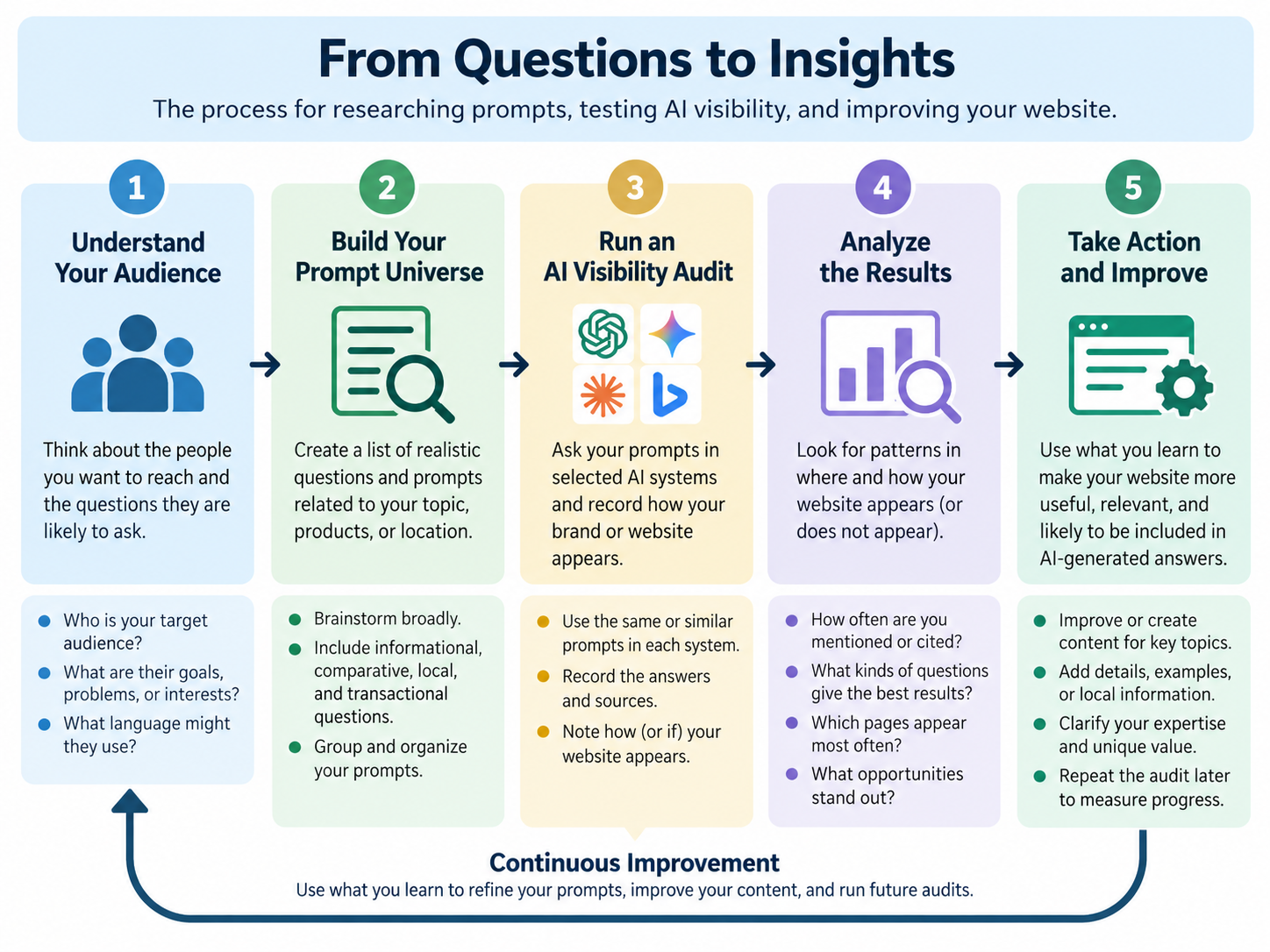
Audience Needs → Prompt Clusters → Priority Prompts → AI Systems → Visibility Outcomes → Baseline → GEO Opportunities
The first half of the loop helps you decide what to test. The second half helps you see what is happening now. Your later GEO work should respond to what you learn.
1. Audience Needs
What problems, decisions, questions, comparisons, and goals cause your audience to seek help?
2. Prompt Clusters
Which questions belong together because they represent the same underlying need or decision?
3. Priority Prompts
Which prompts matter most to your audience and your business — and which create a realistic opportunity for your website?
4. AI Systems
Where might your audience actually ask these questions? You will test more than one system when practical.
5. Visibility Outcomes
Are you mentioned, cited, accurately described, recommended, or ignored? Which competitors and sources appear?
6. Baseline
What does visibility look like right now, before the rest of your GEO improvements?
7. GEO Opportunities
What content, evidence, structure, authority, or clarity should you improve because of what the audit revealed?
Key Terms
Prompt research
The process of identifying the natural-language questions, requests, and situations your audience may bring to an AI system.
Prompt universe
The larger collection of prompts that could reasonably matter to your audience and website.
Prompt cluster
A group of related prompts that express a similar underlying intent, problem, decision, or topic.
Priority prompt
A prompt selected for regular testing because it is especially relevant to the audience, business, or GEO strategy.
AI visibility
The degree to which a brand, website, product, person, or source appears meaningfully in AI-generated answers.
Baseline
A starting measurement captured before later improvements so future results can be compared with it.
Brand mention
The AI names the brand, organization, product, person, or website.
Citation
The AI visibly references or links to a page or source.
Accurate description
The AI describes the brand, product, service, or content correctly.
Recommendation
The AI actively suggests the brand, product, service, or source as a useful option.
Competitor presence
A competing brand, source, organization, or alternative appears in the answer.
Visibility gap
An important prompt or prompt cluster where your website has little or no presence but relevant competitors or sources do.
Before Class 1: Build Your Prompt Universe
Complete this section before the first class period of Week 5.
This section will help you identify the questions your audience is likely to ask and decide which ones are worth tracking.
Your graded Prep Ticket for this section is located in Canvas.
From Keywords to Questions
Traditional SEO often begins with keywords. GEO still benefits from understanding topics and search demand, but conversational AI changes the shape of the research.
A person does not have to type a short phrase such as beginner piano teacher training. They can explain the whole situation:
“I play piano pretty well but I have never taught before. How can I start teaching beginners without making lessons boring?”
The wording is longer, but the underlying need is clearer. The user wants a path from piano player to beginning piano teacher.
For GEO, we care about that underlying need — and the many ways a real person might express it.
Start With the Audience, Not the AI
Do not begin by asking, “What prompts can I rank for?” Begin with the person.
Ask:
- What problems are they trying to solve?
- What decisions are they trying to make?
- What are they comparing?
- What are they uncertain about?
- What would make them ask for a recommendation?
- What would they want to know before trusting a solution?
- What changes when the situation is local, current, expensive, risky, or unfamiliar?
Useful Prompt Categories
You can use these categories to make sure your prompt universe is not too narrow.
Problem prompts
The user describes a problem before knowing the solution.
“I know how to play piano, but how do I learn to teach beginners?”
How-to prompts
The user wants instructions or a process.
“How do I structure a 30-minute first piano lesson?”
Comparison prompts
The user is choosing between approaches or options.
“Is a method-based piano curriculum better than creating my own lesson plans?”
Recommendation prompts
The user wants the AI to suggest a person, product, service, resource, or approach.
“What is a good training program for someone who wants to become a beginning piano teacher?”
Trust prompts
The user is evaluating credibility, risk, evidence, or quality.
“What should I look for before buying a piano-teacher training course?”
Local or current prompts
The answer depends on location, timing, availability, pricing, rules, or other changing information.
“What beginner piano teacher workshops are available in eastern Idaho this month?”
Brand-adjacent prompts
The user does not name your brand but asks a question your brand should eventually be relevant to.
“What resources help new piano teachers keep young students engaged?”
Build Prompt Clusters, Not a Random List
Twenty unrelated prompts are difficult to interpret. Twenty prompts organized into a few meaningful clusters can reveal where your site should compete.
For example, a piano-teacher training website might have these clusters:
- Starting to teach: How do I begin teaching piano? What should I charge? What do I need before taking my first student?
- Lesson structure: What should happen in a first lesson? How long should lessons be? What should beginners practice?
- Student motivation: How do I keep children engaged? What if a student refuses to practice?
- Business and parents: How do I communicate with parents? What policies should a new teacher have?
- Training and resources: What courses, templates, books, or systems can help a new teacher?
Notice that each cluster could eventually become a part of the website’s content architecture. Prompt research can help reveal what the site needs to become.
Do Not Overfit to One Exact Wording
AI systems are conversational. Two prompts with different wording may represent almost the same intent.
For example:
- “How do I start teaching piano?”
- “I can play piano. How do I become a teacher?”
- “What does a new piano teacher need to know before taking students?”
Treat these as related expressions of the same need rather than three completely separate markets.
Prioritize the Prompts That Matter
Your prompt universe can become large quickly. You do not need to audit every prompt every week.
A useful priority prompt usually scores well on several of these questions:
- Audience importance: Does the audience genuinely care about this question?
- Business relevance: Would visibility here matter to the website’s goals?
- Answer fit: Could your website credibly become part of a good answer?
- Retrieval advantage: Does the question benefit from specific, local, current, niche, original, or experience-based information?
- Action potential: Could this question eventually lead someone toward a useful next step?
A simple rule: Do not choose prompts only because they sound easy. Choose prompts where being part of the answer would actually matter.
You will refine this list throughout the semester. Prompt research is a working model, not a permanent contract.
Activity 5A: Build Your First Prompt Universe
Create at least four prompt clusters for your website. Then write 3–5 realistic prompts in each cluster.
Aim for roughly 12–20 prompts total.
As you work, ask yourself:
- Would a real member of my audience actually ask this?
- Does the prompt express a meaningful need or decision?
- Is the wording natural rather than stuffed with SEO terms?
- Could my website eventually deserve to appear in the answer?
- Which prompts are broad, and which are specific?
- Which prompts are likely to require retrieval?
Choose Your Priority Set
From your larger prompt universe, select 6–10 prompts you believe are most important to test in your baseline audit.
Try to include more than one type of intent rather than choosing ten nearly identical questions.
Prepare for Class
Complete Prep Ticket 5A in Canvas. Be ready to show your prompt clusters, explain your strongest priority prompt, and identify one prompt you are unsure whether to keep.
Before Class 2: Run a Baseline AI Visibility Audit
Complete this section before the second class period of Week 5.
This section turns your priority prompts into a repeatable visibility audit.
Your graded Prep Ticket for this section is located in Canvas.
A Baseline Is a Starting Point, Not a Grade
You may run your first audit and discover that your website is never mentioned.
That is not failure. It is data.
A useful baseline tells you what the AI systems do before you make the rest of your GEO improvements. If your visibility changes later, you will have something to compare against.
What Should You Measure?
For each priority prompt, record more than a simple yes/no.
- Brand mention: Is your brand, website, product, person, or organization named?
- Citation: Is one of your pages visibly cited or linked?
- Accurate description: If you are mentioned, is the description correct?
- Recommendation: Are you actively suggested as an option?
- Position or prominence: Are you central to the answer, briefly mentioned, or buried among many alternatives?
- Competitor presence: Which other brands or alternatives appear?
- Source presence: Which websites or source types are cited?
- Answer pattern: What seems to matter in the answer — local detail, authority, comparison, reviews, current information, original evidence, or something else?
Audit More Than One AI System
Different systems can retrieve different sources and produce different answers. When practical, test the same priority prompts in at least two AI systems available to you.
You are not trying to decide which AI system is “best.” You are trying to see whether your visibility depends on the system being used.
Keep the Test as Consistent as Practical
AI-generated answers are not perfectly repeatable, but you can make your audit more useful by reducing unnecessary differences.
- Use the same exact prompt wording across the systems you are comparing.
- Use a new conversation when practical so earlier prompts do not shape the answer.
- Do not include your brand name in a discovery prompt unless the purpose of that prompt is specifically to test brand understanding.
- Record the date and AI system used.
- Save screenshots or copied answer excerpts when useful.
- Do not repeatedly rerun a prompt until you get the result you wanted.
Audit Integrity Rule
Measure what the system naturally does before trying to influence the answer.
If you first tell the AI all about your company and then ask whether it recommends your company, you are no longer measuring baseline discovery.
Activity 5B: Run Your Baseline Audit
Use your 6–10 priority prompts.
For each prompt, test the AI systems you selected and record the outcomes.
A simple audit record might include:
- Prompt
- Prompt cluster
- AI system
- Date
- Brand mentioned? Yes / No
- Website cited? Yes / No
- Description accurate? Yes / No / Not applicable
- Recommended? Yes / No
- Competitors or alternatives mentioned
- Sources cited
- Short observation
Keep the process simple enough that you could reasonably repeat it later in the semester.
Look for Patterns Across Prompts
Individual answers are interesting. Patterns are more useful.
After testing your priority prompts, ask:
- Which prompt clusters have the strongest visibility?
- Where are competitors consistently appearing?
- Which source types appear repeatedly?
- Which questions seem to trigger retrieval?
- Where is your brand missing entirely?
- Where is your brand mentioned but not cited?
- Where is your site described incorrectly or incompletely?
- Which prompts seem like realistic opportunities for improvement?
Do Not Turn the Baseline Into False Precision
AI answers can vary. Your results can be affected by model updates, retrieval behavior, location, personalization, time, and other factors you may not be able to see.
So avoid statements such as:
“Our AI visibility score is exactly 37.5%, therefore we have improved by 4.2%.”
At this stage, your audit is better treated as a structured snapshot of observable behavior.
Later, repeated measurements can become more informative because you will be comparing patterns over time.
Find Your Visibility Gaps
A visibility gap is not simply a prompt where you are absent. It is a prompt that matters to your audience and business where other relevant sources are already being used.
Those gaps can help guide later work.
For each important gap, ask:
- Do we have a page that deserves to answer this question?
- Is that page clear and specific enough?
- Do competitors provide information we do not?
- Are we missing evidence, examples, experience, or current detail?
- Does the AI misunderstand what our brand or website is?
- Is the problem really content — or is it trust, entity clarity, authority, retrieval, or something else?
Do not try to fix everything this week. The remaining modules will give you more tools for doing that.
Observe Before You Explain
As with the retrieval work from Module 4, separate what you can observe from what you can only infer.
You can observe that a competitor appears in seven of your priority prompts. You usually cannot prove exactly why the AI system selected that competitor.
A good GEO audit records the outcome first and investigates possible causes second.
Prepare for Class
Complete Prep Ticket 5B in Canvas. Be ready to show one important visibility pattern, one competitor or source that appeared repeatedly, and one visibility gap you think is worth investigating.
Save to Your GEO Portfolio
Save the following from this module:
- Your prompt universe
- Your prompt clusters
- Your 6–10 priority prompts
- Your baseline AI visibility audit
- Screenshots or evidence from selected prompts
- A list of competitors or sources that appeared repeatedly
- Your most important visibility gaps
- A short note describing the GEO opportunity you currently think is most promising
Module Summary
Prompt research gives your GEO work a target. AI visibility auditing gives it a starting measurement.
This week you moved beyond asking whether your site “shows up in AI.” You identified the kinds of questions your audience may actually ask, grouped them into meaningful clusters, selected priority prompts, and created a repeatable baseline.
That baseline will become more valuable as the semester continues. You will improve entity clarity, answer quality, topical authority, trust, structured data, technical foundations, and off-site authority — and then you can return to these prompts to see what changed.
Next: We will examine entities, knowledge graphs, and brand understanding — because before an AI system can accurately recommend you, it needs a clear idea of who or what you are.