
THE GEO FRAMEWORK
Generative Engine Optimization: a practical framework for AI visibility
GEO is the discipline of improving the likelihood that AI-powered search and answer systems can find, understand, trust, and use your content when generating responses.
It builds on SEO rather than replacing it. Strong technical foundations, clear entities, useful content, authority, and accessibility still matter. GEO adds a new optimization goal: becoming useful source material for generated answers.

The core GEO mental model
A useful way to think about GEO is as a progression from technical eligibility to actual selection in an AI-generated answer.
1. Eligibility
Can the page be crawled, accessed, rendered, and retrieved when needed?
2. Understanding
Can the system understand the page, its entities, relationships, topic, and intended meaning?
3. Trust
Is the information credible, well supported, current enough, and consistent with other trusted sources?
4. Selection
Is this source useful enough to mention, cite, summarize, compare, or recommend in the final answer?
How GEO differs from SEO
SEO and GEO overlap heavily, but the visibility outcome is different.
Traditional SEO
- Earn visibility in search results
- Improve rankings and qualified clicks
- Optimize pages for search intent and discoverability
- Measure rankings, traffic, engagement, and conversions
Generative Engine Optimization
- Earn visibility inside generated answers
- Improve mentions, citations, accurate descriptions, and recommendations
- Optimize for retrieval, understanding, evidence, and source usefulness
- Measure visibility across representative prompts and AI systems
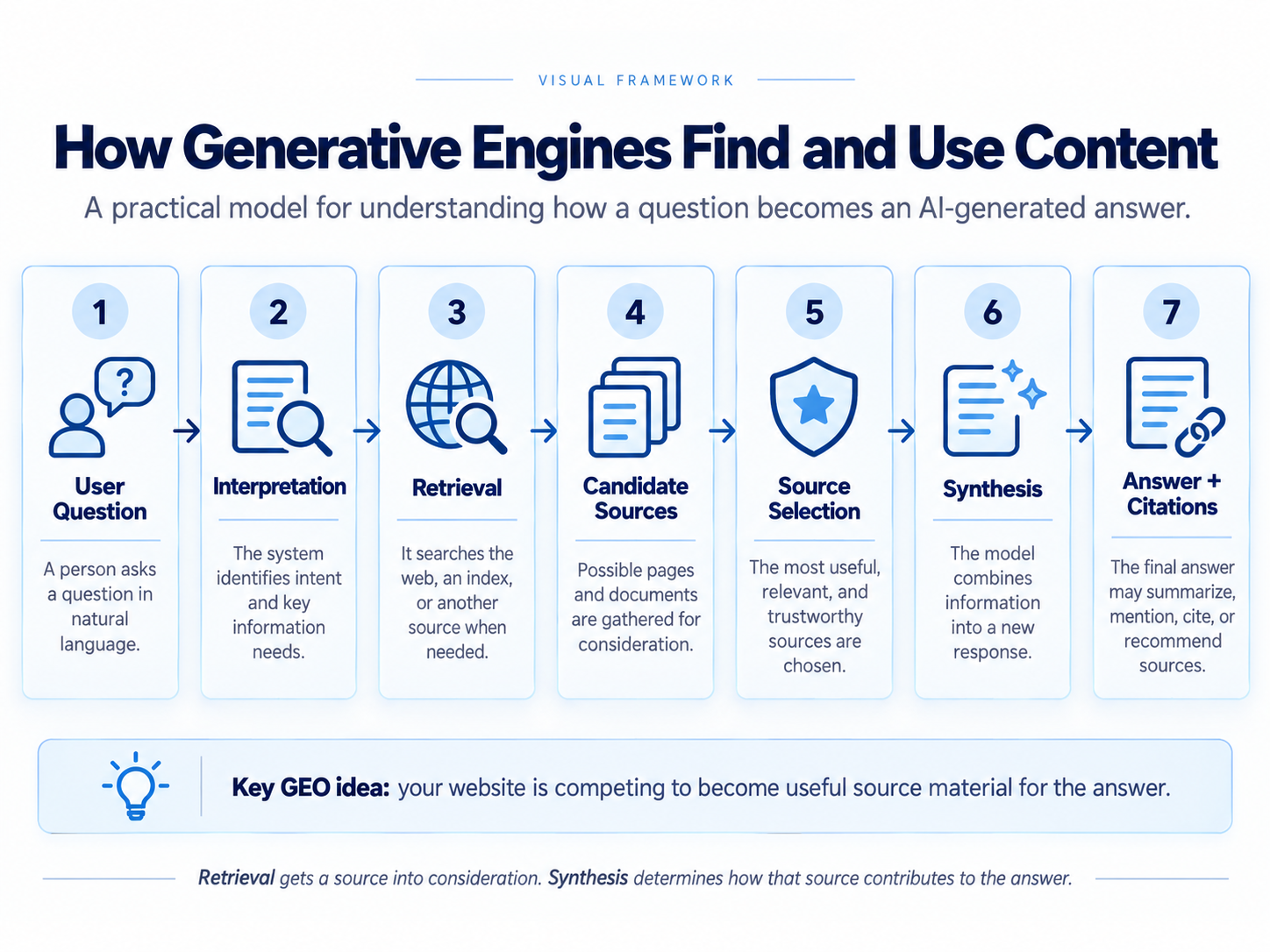
HOW AI ANSWERS GET BUILT
Retrieval changes the optimization problem
Some AI answers are produced largely from learned model knowledge. Others use live or near-live retrieval from the web. When retrieval happens, your page must compete to become useful source material — not simply a blue link.
That is why freshness, locality, niche expertise, original evidence, clear comparisons, and specific experience can create a retrieval advantage for questions that cannot be answered well from generic learned knowledge alone.
The major components of GEO
Each component solves a different visibility problem. Together they create a stronger source for both people and machines.
Entities & Brand Understanding
Clarify who or what your site represents and how those entities relate to topics, products, places, people, and other trusted sources.
Answer-Optimized Content
Write pages that answer real questions clearly, provide extractable passages, and give AI systems enough context to use them accurately.
Schema & Structured Meaning
Use machine-readable structure to reinforce page type, authorship, entities, relationships, and other explicit meaning.
Authority & Recognition
Strengthen the evidence, reputation, citations, references, and source ecosystem that make your information more credible.
Technical Accessibility
Keep important pages crawlable, performant, accessible, internally linked, and technically easy for retrieval systems to process.
Measurement & Experimentation
Track mentions, citations, descriptions, recommendations, competitors, and source patterns across a representative prompt set.
What good GEO work looks like
- It starts with real audience questions, not just keywords.
- It improves the website for people and machines at the same time.
- It distinguishes observed behavior from speculation about hidden algorithms.
- It values evidence, specificity, freshness, and source usefulness.
- It measures change across a set of prompts rather than celebrating one favorable answer.
Where should you go next?
If you want a quick conceptual foundation, start with the GEO overview. If you want a structured learning path with activities and practical application, use the free textbook.